Qi2 Certification Process: Verify Authentic Compliance Safely
By Asha Raman • 3rd Dec
When shopping for wireless charging solutions, understanding the Qi2 certification process is critical for ensuring you're getting a product that delivers safe, reliable power to your devices. As an independent researcher who's spent years analyzing how charging protocols affect lithium-ion battery longevity, I can tell you that authentic certification isn't just about marketing, it directly impacts your device's thermal profile and lifespan. The requirement to verify Qi2 compliance exists for good reason: to protect consumers from substandard products that can accelerate battery degradation through excessive heat. A cool battery is a long-lived battery, and proper certification helps maintain those ideal thermal conditions.
What Exactly is Qi2 Certification and Why Does It Matter?
Qi2 represents the Wireless Power Consortium's (WPC) updated standard that builds upon the original Qi wireless charging specification. If you're comparing Apple's magnetic ecosystem with open standards, our MagSafe vs Qi guide clarifies alignment, speed, and compatibility trade-offs. The 'Qi' name (pronounced "chee") originates from Chinese philosophy, representing the flow of energy, appropriate for a standard focused on wireless power transfer.
Unlike its predecessor, Qi2 introduces stricter Qi2 certification requirements with enhanced authentication protocols. This matters because counterfeit or non-compliant chargers often lack proper thermal management systems, leading to battery temperatures exceeding 43°C (the threshold where accelerated lithium-ion degradation begins).
Verify Qi2 compliance isn't just about faster charging; it's about ensuring your device stays within safe thermal limits during power delivery.
How Does the Qi2 Certification Process Work?
What are the Basic Steps in the Qi2 Certification Process?
The Qi2 certification process involves several rigorous verification steps:
- WPC Membership: Manufacturers must first become members of the Wireless Power Consortium and submit required documentation
- Pre-Compliance Testing: Internal testing to identify potential issues before formal submission
- Formal Testing: Comprehensive evaluation at an Authorized Test Lab (ATL)
- Sample Submission: Typically 5 sets of product samples for testing
- Certification Decision: Usually rendered within 10 working days post-testing
- Database Registration: Approved products appear in the WPC's official Qi Certified database
Only after successfully completing these steps can a manufacturer display the genuine Qi2 logo (a visual indicator of compliance with WPC's stringent requirements). For regional compliance nuances beyond WPC certification, see our global regulations guide.
What Specific Tests Are Conducted During Qi2 Compliance Testing?
Qi2 compliance testing evaluates multiple critical parameters:
- Electrical safety (including overvoltage and short-circuit protection)
- Electromagnetic compatibility (EMC) to prevent interference with other devices
- Thermal performance (measuring maximum operating temperatures under various conditions)
- Foreign object detection (FOD) to prevent heating of metallic objects
- Authentication verification (validating the X.509 certificate chain)
- Coupling efficiency (measuring k-value for proper coil alignment)
- Power transfer stability (assessing consistency across different device orientations)
During thermal testing, products must demonstrate they do not exceed 45°C surface temperature during continuous operation, which is critical for preserving your device's battery health. For measured heat profiles and sustained watt performance across brands, review our wireless charging speed test.
Understanding Qi2 Authentication: How It Protects Your Devices
How Does Qi2 Authentication Differ From Previous Standards?
Qi2 introduces mandatory authentication for all chargers delivering above 5W, addressing a critical vulnerability in earlier standards. The authentication process involves three certificate components:
- Root certificate hash (verified by the receiver)
- Manufacturer certificate (validated against WPC-approved Certificate Authorities)
- Product unit certificate (unique to each charger, signed with the manufacturer's private key)
This multi-layered approach ensures your device only communicates with chargers that have passed rigorous safety testing, preventing potentially dangerous power contracts with uncertified hardware that might lack proper thermal management.
What Happens During the Authentication Process?
When you place your Qi2-compatible device on a certified charger:
- Initial negotiation occurs at Basic Power Profile (BPP) levels (up to 5W)
- The receiver requests the charger's certificate using "Get Certificate" command
- The charger transmits its X.509 certificate chain
- The receiver validates the certificate chain authenticity
- The receiver issues a cryptographic challenge, which the charger must respond to using its private key
- Only upon successful validation can power levels increase beyond 5W
This process prevents unauthenticated chargers from delivering higher power levels that could cause excessive heating.
How to Verify Genuine Qi2 Compliance
What Should Consumers Look For When Purchasing Qi2-Certified Products?
To properly verify Qi2 compliance, consumers should:
- Check for the genuine Qi2 logo: Only certified products may display this official mark
- Search the WPC database: The Wireless Power Consortium maintains a searchable product database
- Confirm Authorized Test Lab involvement: Qi2 certification must pass through one of 11 WPC-authorized labs
- Verify authentication capability: Genuine Qi2 chargers support the full authentication protocol
- Examine product specifications: Authentic products will list Qi2 certification details in documentation
Be wary of products claiming "Qi2 compatible" without showing the official certification logo, because this distinction matters for safety and performance.
What Are Common Red Flags for Non-Compliant Products?
Warning signs include:
- Price points significantly below market average
- Vague claims like "Qi2 ready" or "Qi2 compatible" without certification proof
- Missing genuine Qi2 logo on product or packaging
- No mention of authentication protocols in technical specifications
- Absence from the official WPC product database
I recall a summer road trip where a bargain 'fast' mount cooked my phone above 43°C. Navigation stuttered, battery estimate plummeted, and I spent an hour troubleshooting in a parking lot. Authentication would have prevented this substandard charger from delivering unsafe power levels.
Why Certification Matters for Battery Longevity
How Does Qi2 Certification Relate to Battery Health?
The connection between certification and battery lifespan is direct and scientifically established. Properly certified chargers maintain thermal conditions that preserve battery health:
- Certified products include precise thermal management systems
- Authentication prevents incompatible power contracts that cause overheating
- Certified chargers implement proper power throttling when temperatures rise
- Verification ensures foreign object detection works correctly
Multiple studies, including research published in the Journal of Power Sources, confirm that lithium-ion batteries maintained below 35°C during charging exhibit significantly slower capacity fade compared to those regularly exposed to temperatures above 40°C.
Practical Steps to Protect Your Battery with Qi2-Certified Products
To maximize battery longevity:
- Always verify Qi2 compliance through the WPC database before purchasing
- Choose chargers with proper thermal design (avoid ultra-thin models that restrict heat dissipation)
- Monitor device temperature during charging (discontinue use if exceeding 40°C)
- Use the correct power adapter (18W+ USB-C PD for full 15W Qi2 performance)
- Remove thick cases during charging to improve heat transfer
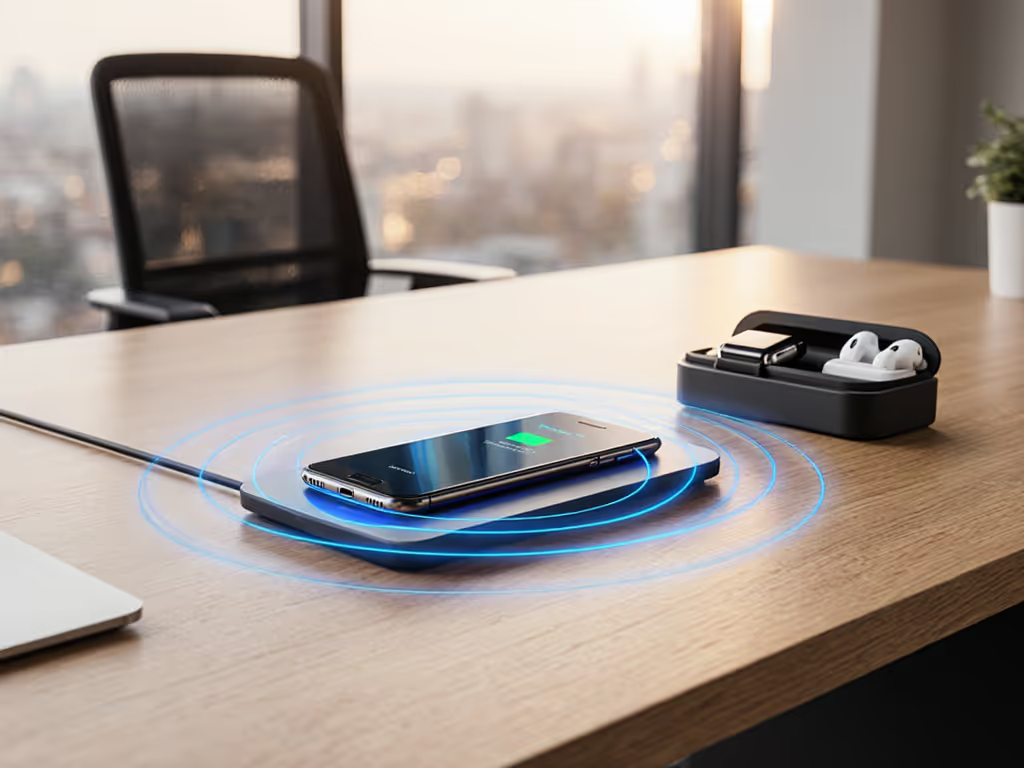
When setting up your workspace, consider a Qi2-certified 3-in-1 charging station like the Mophie Snap+ stand that properly manages thermal conditions across multiple devices. Android users can compare options in our Qi2 3-in-1 charger guide.
Conclusion: Certification as a Foundation for Safe, Long-Lasting Charging
Understanding the Qi2 certification process empowers you to make informed decisions that protect your investment in premium devices. Verification isn't merely bureaucratic, it is a critical safeguard against products that could compromise your device's battery health through excessive heat generation. As I've learned from tracking thermal profiles across hundreds of charging scenarios, protecting the battery pack through authenticated, certified charging solutions pays dividends in extended device lifespan.
As the saying goes: Protect the pack, and performance naturally lasts the distance. Health-first beats hype, especially when it comes to preserving your device's battery longevity through verified, compliant charging solutions.
Related Articles