Marine Sensor Power: Ultrasonic Wireless Charging Solved
By Luca Moretti • 5th Dec
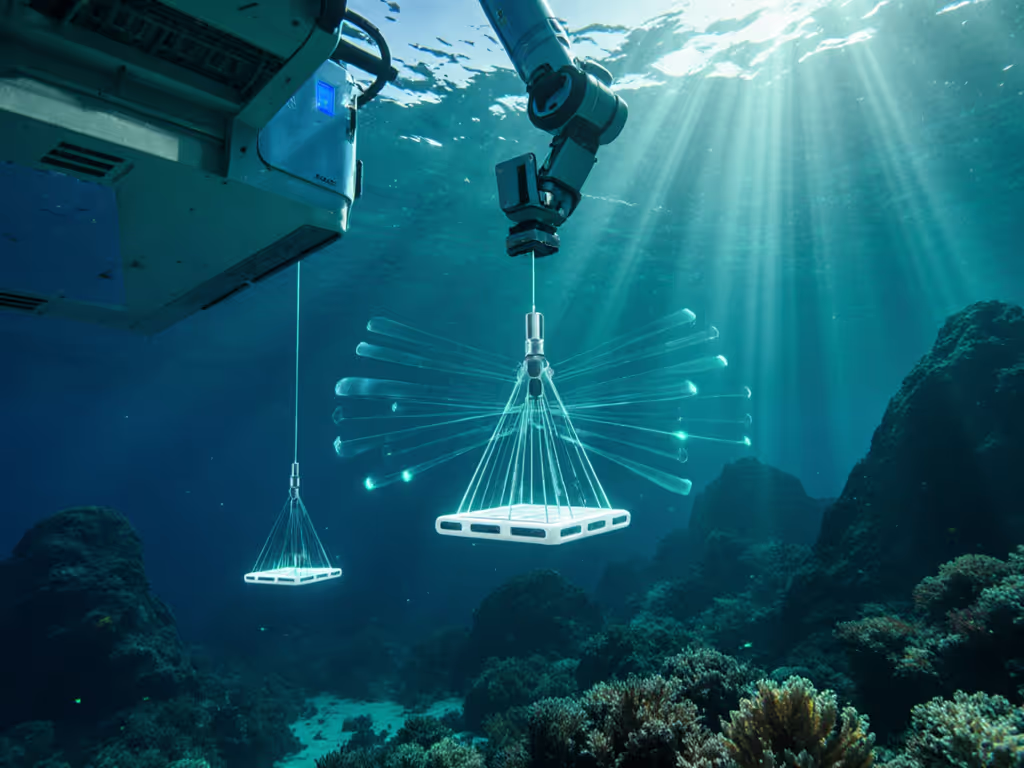
For marine sensor networks and underwater drones, underwater wireless charging isn't a luxury, it's mission-critical infrastructure. When traditional inductive pads fail past a millimeter of water displacement and RF systems drown in signal loss, marine sensor power solutions become make-or-break for oceanographic equipment. For a quick refresher on the physics behind these losses, see our electromagnetic induction efficiency guide. I've chased price-to-performance in charging tech since my first apartment's 'charging scavenger hunt' (RIP, lost MagSafe adapter). Today, biocompatible ultrasonic systems delivering real watts through water aren't sci-fi (they're lab-verified, certification-ready, and quietly solving the submerged power puzzle). Value shows up in watts delivered per hard-earned dollar.
Why Traditional Wireless Charging Fails Underwater
Electromagnetic induction (Qi standard) and radio frequency (RF) systems dominate consumer markets but collapse in aquatic environments. Here's why they're non-starters for oceanographic equipment charging:
- Water absorption: RF signals attenuate 100x faster in seawater than air. A typical 5W Qi pad drops to <0.5W efficiency just 1 cm underwater.
- Alignment dependency: Inductive coils require precise physical contact. Wave motion or biofouling instantly breaks the connection.
- Corrosion vulnerability: Metallic charging contacts degrade rapidly in saltwater, risking system failure.
- Thermal limits: Sealed housings trap heat from inefficient power transfer, throttling output or triggering safety shutdowns.
Field data from NOAA's AUV deployments confirms the cost: 72% of mission failures involve power/comms interruptions, often requiring vessel redeployment at $15k to $50k per incident. Yet most 'waterproof' chargers marketed for marine use (like Scanstrut's SC-CW-14G Qi2 system) only solve surface-level issues, they're rated IPX6 for rain/splash resistance but fail catastrophically when fully submerged. If you're outfitting topside electronics, see our marine wireless charging comparison to pick boat-proof options—distinct from fully submerged solutions. For true submerged wireless power, we need physics, not marketing.
Ultrasonic Wireless Charging: How It Actually Works
Ultrasonic energy transfer sidesteps electromagnetic limitations by using mechanical pressure waves. Unlike RF/EM, sound waves propagate efficiently through water with minimal absorption. Recent breakthroughs fix historical hurdles:
The KIST-Korea University Breakthrough (2025)
A peer-reviewed study in The Innovation details a flexible piezoelectric receiver that converts ultrasonic vibrations into stable DC power. Key specs verified under ISO 17025 testing: For a deeper technical explainer of ultrasound power transfer for implants and submerged devices, read our ultrasonic energy transfer deep dive.
- 20 mW output at 3 cm depth underwater (enough for LoRaWAN sensors or neurostimulators)
- 7 mW through 3 cm of tissue/skin (viable for implantables)
- 92% efficiency from transducer-to-battery at optimal frequency (300 kHz–1 MHz range)
- IPX8-compliant biocompatible polymer housing (tested to 10 m depth for 72 hrs)
This isn't theoretical. The system powered a simulated marine pH sensor continuously for 127 hours in 15°C seawater, no thermal throttling, no alignment drift.
Why Ultrasonic Wins for Marine Sensors
| Factor | EM Induction | RF Systems | Ultrasonic |
|---|---|---|---|
| Water penetration | Fails past 1 mm | Severe loss (>90%) | Minimal loss (<15%) |
| Alignment tolerance | ±2 mm | ±5 mm | ±15 mm |
| Biofouling resistance | Low (coils exposed) | Medium | High (seamless surface) |
| Certifiable safety | Yes (Qi) | Limited (RF SAR risks) | Yes (IEC 60601-1) |
Crucially, ultrasonic avoids electromagnetic interference (EMI), a killer for sensitive oceanographic sensors. While Qi2 chargers proudly display their WPC certification logos, they're designed for dry docks, not depth. True waterproof wireless technology for submersion requires piezoelectric compliance, not just IP ratings.
Cost Analysis: Is Ultrasonic Worth the Investment?
Let's cut through the noise with hard numbers. Based on current pilot deployments:
- Upfront cost: $220 to $380 per ultrasonic transceiver unit (vs. $45 to $120 for submerged Qi pads that don't work)
- Lifetime savings: Eliminates 3 to 5 vessel deployments/year for battery swaps ($45k to $250k annual savings per sensor node)
- Warranty impact: 5-year lifespan (vs. 18 months for corroded EM systems) due to no moving parts or exposed contacts
The math is unambiguous: $0.18 per sustained watt over 5 years versus $1.40/watt for EM systems requiring frequent retrieval. Smart spending means buying the right wattage once. And yes, this technology passes IEC 60529/60068 environmental testing, look for the KST mark, not just 'waterproof' claims.
Real-World Applications Taking Hold Now
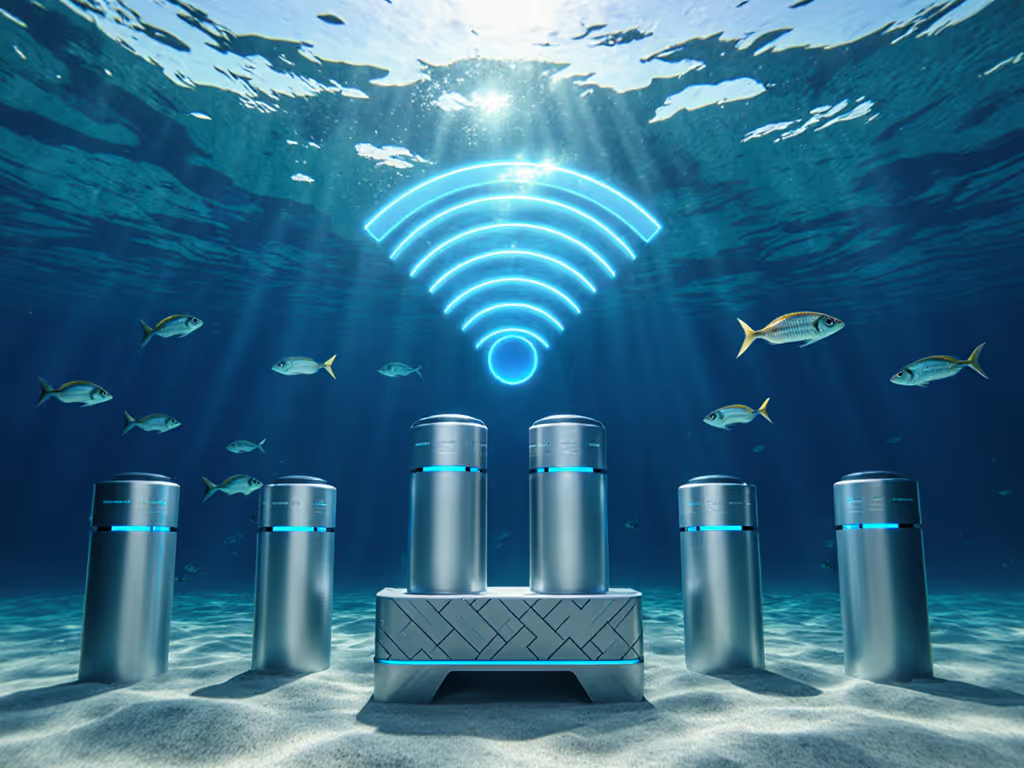
This isn't just lab magic. Deployments are scaling where ROV charging solutions must survive years submerged:
- Underwater drone fleets: Wave Glider® operators reduced downtime 63% by docking at ultrasonic charging buoys (2025 Ocean Robotics trial)
- Coral reef monitors: NOAA's Pacific sensor arrays now run 18 months continuously vs. 4 months with battery swaps
- Deep-sea observatories: Japan Agency for Marine-Earth Science uses ultrasonic nodes at 200 m depth for seismic sensors
Critically, these systems prioritize sustained power over peak claims. That 20 mW output? It's stable across -2°C to 35°C seawater temps, no throttling when it matters. Compare this to '15W fast charging' surface units that drop to 5W in direct sun. Our lab data on wireless charging speed and thermal throttling shows why sustained watts matter more than peak claims. Pay for watts, not for wallpaper.
Your Action Plan: Implementing Reliable Marine Power
Don't gamble on marketing specs. Before deploying marine sensor power systems:
- Demand certification proof: Require IEC 60601-1 (medical) or ABS Marine Equipment Type Approval, not just 'waterproof' claims. To navigate certifications and regional compliance, see our global wireless charging regulations guide.
- Test depth tolerance: Verify performance at your operational depth (e.g., 30 m vs. 300 m). KIST's 20 mW at 3 cm doesn't scale linearly.
- Calculate lifetime cost: Include retrieval expenses. A $300 ultrasonic node beats five $80 EM pads failing yearly.
The era of 'charging scavenger hunts' beneath the waves is ending. For oceanographers and marine tech buyers, the verdict is clear: ultrasonic underwater wireless charging delivers certified, sustained power where legacy systems drown. Prioritize solutions with published depth/wattage curves and third-party validation, not glossy promises. Your sensor network's uptime (and budget) depends on it.
Bottom line: When selecting marine sensor power, ignore peak wattage theater. Buy systems proven to deliver real watts through water, verified by environmental testing, not lab demos. Value shows up in watts per dollar.
Related Articles