Medical vs Consumer Wearables Charging: Avoid Heat Damage
By Asha Raman • 7th Feb
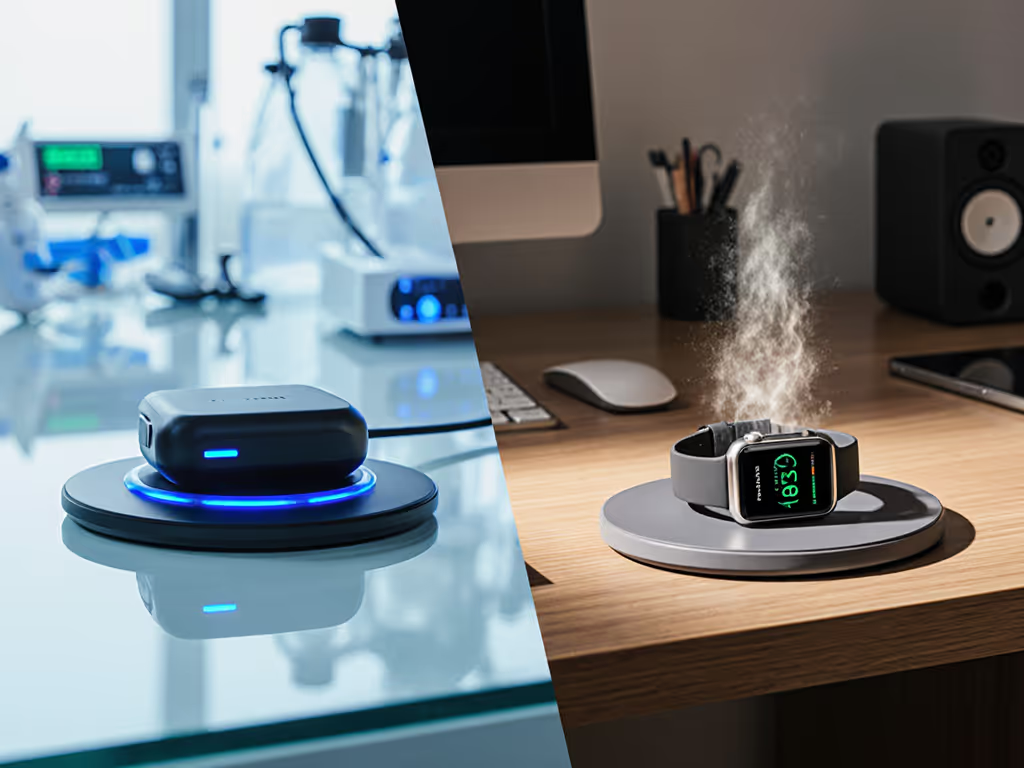
Today's wearable market spans from consumer fitness trackers to regulated medical devices, yet few users recognize the critical differences in how these gadgets manage charging (particularly when it comes to heat generation and battery longevity). As an independent researcher focused on lithium-ion longevity in consumer devices, I've observed how understanding medical vs consumer wearables charging protocols can significantly extend the service life of your everyday tech. While consumers prioritize convenience, medical devices operate under stringent medical device charging standards that place thermal safety above all else. This distinction matters because a cool battery is a long-lived battery, whether you're wearing a smartwatch or a continuous glucose monitor.
Why Medical Wearables Charge Differently
Q: What fundamentally separates medical-grade wearable charging from consumer models?
Medical devices operate under fundamentally different risk parameters. For a plain-English overview of global device certifications (FDA, FCC, CE) that govern safe chargers, see our wireless charging regulations guide. Where your smartwatch might tolerate brief temperature spikes during fast charging, implantable or clinical-grade wearables must maintain strict thermal boundaries to prevent tissue damage or diagnostic errors. According to IEC 62133 standards referenced in FDA guidance, medical batteries require:
- Maximum operating temperature limits of 40°C (vs 45°C in many consumer devices)
- More rigorous overcharge protection circuits
- Stricter thermal runaway prevention protocols
- Enhanced monitoring of state of charge (SOC) and state of health (SOH)
These requirements translate to inherently more conservative low-power wearable charging profiles. While your phone might accept 15W bursts during Qi2 charging, a medical device like a continuous glucose monitor often charges at 5W or less, even when using ostensibly the same wireless technology, to maintain thermal equilibrium. This cautious approach explains why medical devices rarely implement "fast charging" modes common in consumer wearables.
Q: How do battery chemistry choices reflect these different priorities?
Medical devices frequently favor LiFePO4 (lithium iron phosphate) batteries over the NMC (nickel manganese cobalt) chemistry dominating consumer wearables. While NMC offers higher energy density (150-220 Wh/kg), LiFePO4 provides:
- Wider temperature tolerance (-20°C to 60°C vs NMC's 0°C to 45°C)
- Longer cycle life (2000-7000 cycles vs 1000-2000)
- Greater thermal stability
These characteristics align with medical applications where battery failure isn't merely inconvenient, it could compromise patient safety. Manufacturers like Analog Devices have developed specialized chips (MAX86176/78 family) that integrate precise thermal monitoring with charging management specifically for medical wearables, something rarely found in consumer-grade equivalents.
Wireless Charging Nuances
Q: Are the wireless charging standards themselves different?
The underlying physics of inductive coupling remains consistent across both sectors, but implementation differs significantly. Consumer wireless charger systems (like Qi2) prioritize speed and user convenience, sometimes at a thermal expense. Medical implementations:
- Incorporate mandatory thermal sensors at both charger and device
- Implement immediate power throttling at 38°C (vs 42°C+ in consumer devices)
- Require redundant overtemperature cutoffs
- Often use lower-frequency fields that generate less heat
Powermat's Smartinductive technology for medical applications demonstrates this philosophy. For implantable and clinical devices specifically, see our medical charging safety guide. It is engineered specifically to reduce heat generation during power transfer, acknowledging that "the difference between life and death" often hinges on maintaining thermal equilibrium in sensitive medical contexts.
Q: How does battery size impact charging requirements?
This is where small device power solutions become critical. For ultra-low-power wearables like rings and sensors, learn how NFC power transfer reduces heat risk. Both medical and consumer wearables face the same physics challenge: smaller batteries require higher charging precision. As noted in component engineering literature, a typical smartphone's 2,000 mAh battery uses a 1.2A (0.6C) charging current with cutoff at 60-120mA, whereas a medical wearable with a 100mAh battery needs cutoff accuracy in the 0.5-1mA range.
This precision requirement explains why medical wearables invest in more sophisticated battery management systems (BMS). Consumer devices often cut corners here to reduce costs, resulting in less precise charge termination that can contribute to long-term battery degradation through subtle overcharging.
The Heat Longevity Connection
Q: How exactly does heat damage wearable batteries?
Thermal stress accelerates battery degradation through three primary mechanisms: For the fundamentals behind heat generation and mitigation, read wireless heat and safety.
- SEI layer growth: At 35°C+, the solid-electrolyte interphase layer thickens, consuming active lithium
- Electrolyte decomposition: Temperatures above 40°C trigger chemical breakdown
- Cathode oxidation: Particularly problematic in NMC batteries common to consumer wearables
Research consistently shows that maintaining lithium-ion batteries below 35°C during charging can double their usable lifespan compared to frequent exposure to 40°C+. This is why medical devices, designed for multi-year continuous operation, implement such aggressive thermal management. Consumer devices, optimized for lower initial cost, often prioritize speed over longevity.
Q: What temperature thresholds should consumers monitor?
Based on my analysis of battery stress testing data, I recommend these practical thresholds for consumer wearables:
- Optimal: 25-30°C during charging (room temperature)
- Acceptable: Up to 35°C (slight warmth, but no long-term damage)
- Concerning: 38°C+ (accelerated degradation begins)
- Damaging: 42°C+ (immediate capacity loss)
When a wearable consistently charges above 35°C, its battery capacity may decline 30-50% faster than a device maintained within optimal thermal ranges. This is where consumers can borrow medical-grade thinking: protect the pack, and performance naturally lasts the distance.
Practical Safeguards for Consumers
Q: How can I apply medical-grade thermal management to my consumer wearables?
You don't need hospital-grade equipment to implement smarter charging habits. Consider these evidence-backed modifications to your routine:
- Avoid overnight charging at room temperatures above 25°C (use scheduling features to complete charging by morning)
- Remove thick cases during charging sessions, many cases trap heat that would otherwise dissipate
- Prefer indirect charging (e.g., a charging stand rather than pressed against skin)
- Monitor temperature with apps like AccuBattery (Android) that track charging thermals
- Choose chargers with thermal sensors, some premium wireless charger models now include this feature
Health-first beats hype. The most sophisticated charging system is worthless if it cooks your battery.
Q: Should I consider energy harvesting options?
Energy harvesting for wearables represents a promising frontier that bridges medical and consumer applications. Explore the pros, limits, and use cases in our deep dive on energy harvesting power. Technologies like:
- Photovoltaic cells (power from ambient light)
- Piezoelectric elements (power from movement)
- Thermoelectric generators (power from body heat)
These approaches reduce reliance on traditional charging cycles, thereby minimizing thermal stress. While current implementations (like Withings' solar-powered ScanWatch) provide supplemental rather than primary power, they represent an important direction for low-power wearable charging that reduces heat exposure entirely.
Conclusion: The Long View on Battery Health
The divide between medical and consumer wearables charging reflects fundamentally different risk calculations. Medical devices prioritize absolute reliability and longevity, while consumer products often sacrifice long-term battery health for immediate convenience. However, by adopting medical-grade thermal consciousness in your charging habits, you can significantly extend your devices' service life.
Modern wearables, whether tracking your steps or your blood glucose, share the same lithium-ion chemistry vulnerable to heat damage. By recognizing that medical vs consumer wearables charging protocols differ primarily in thermal management rigor, you gain actionable insights to protect your investment. Remember that battery longevity isn't about finding faster chargers, it is about finding smarter ones that prioritize thermal equilibrium.
Further Exploration
To deepen your understanding of wearable charging dynamics:
- Review the FDA's guidance document "Battery-Powered Medical Devices: Guidance for Industry and Food and Drug Administration Staff" (2025)
- Study IEC 62133-2:2017 standards for secondary cells and batteries containing alkaline electrolytes
- Track ongoing research in solid-state battery technology, which promises significantly improved thermal stability for future wearables
- Experiment with your own thermal monitoring using infrared thermometers during charging sessions
The most sophisticated charging ecosystem isn't the fastest, it is the one that maintains your devices' health longest. When evaluating new wearables or chargers, prioritize thermal management specifications alongside headline speed claims. Your future self (and your device battery) will thank you when your gadgets are still performing reliably years later.
Related Articles