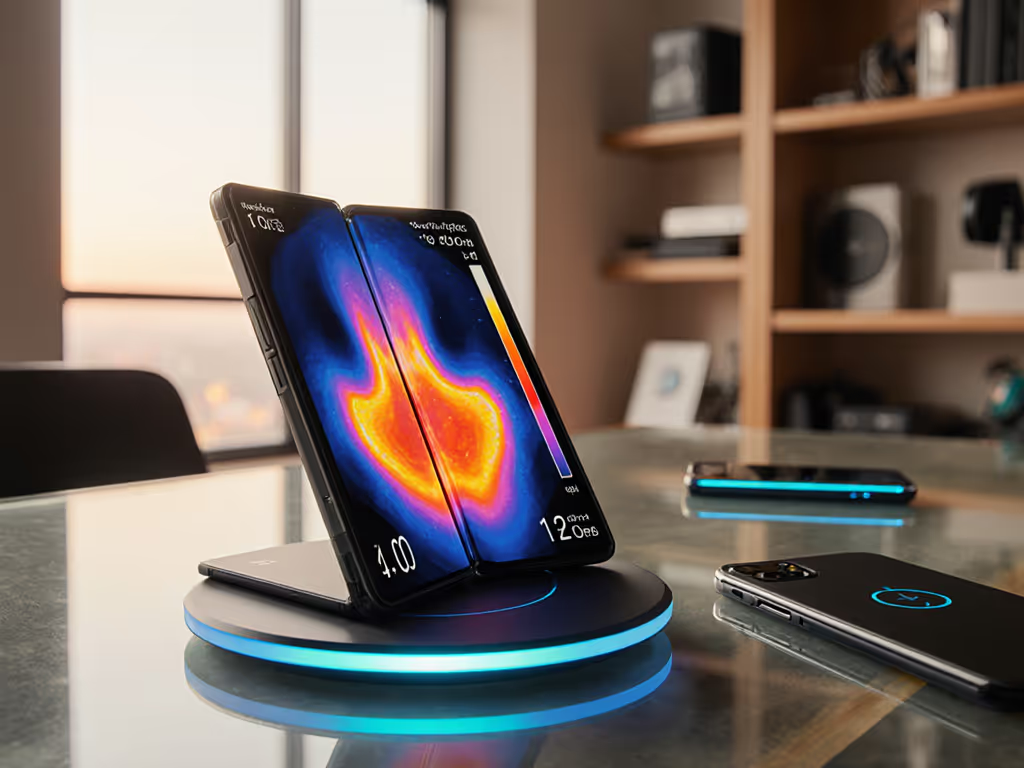
Qi2.2 vs Qi2: Cooler, Faster, Safer Wireless Charging
By Asha Raman • 19th Feb
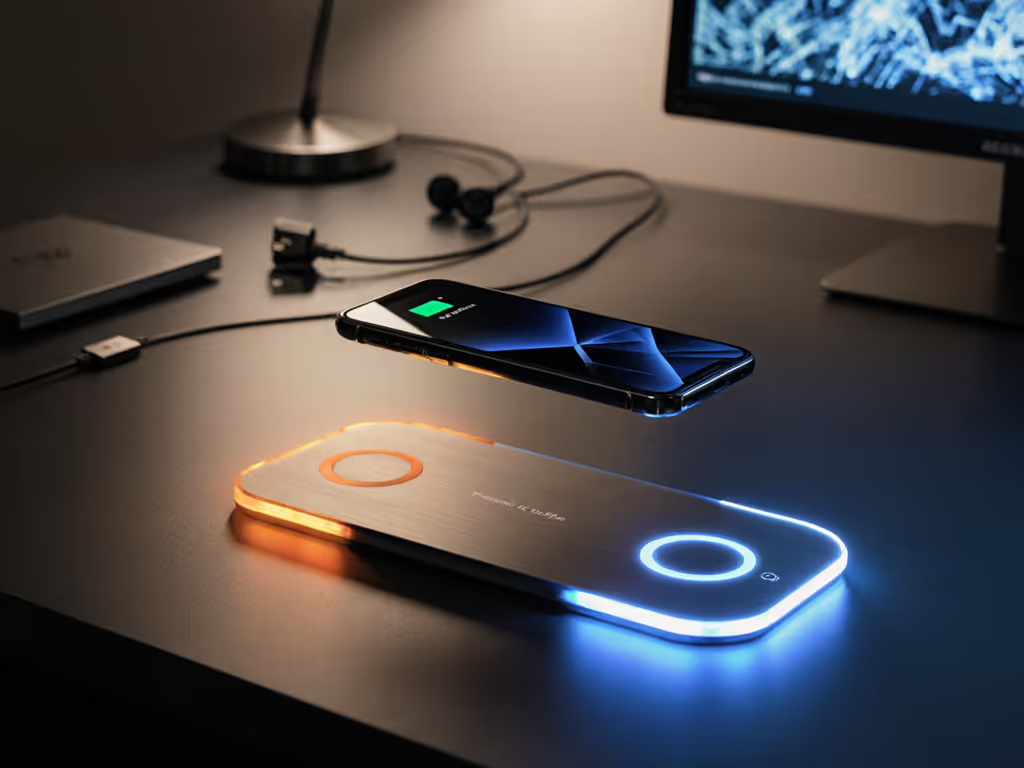
The jump from Qi2 to Qi2.2 represents a wireless charging standard evolution that matters far more than the modest version bump suggests, and not just because of the speed increase. While Qi2 capped out at 15W of power delivery, a Qi2.2 vs Qi2 comparison reveals a shift toward what the industry calls "closed-to-wired parity": faster charging without the thermal penalty that plagued older wireless pads. For anyone tired of choosing between speed, battery anxiety, and heat, this distinction is worth understanding. If you're weighing cables vs pads, our wireless vs wired charging comparison breaks down real-world speed, convenience, and battery wear.
The core difference is straightforward: Qi2.2 allows up to 25W of wireless power, roughly 67% more than Qi2's 15W ceiling. But that number alone misses the real story. The upgrade also refines the Magnetic Power Profile (MPP), the standardized blueprint that dictates magnet placement, alignment tolerance, and power negotiation, which keeps devices cooler and more stable under load. This is the engineering detail that separates a fast charger from a safe fast charger.
Why The Standard Matters: From Guesswork to Precision
Before Qi2, wireless charging was a gamble. A device would land on a pad, magnets might help or might not, and chargers would deliver inconsistent power while heat crept higher than anyone liked. I learned this the hard way during a summer road trip: a bargain "fast" mount left my phone overheating above 43°C, navigation stuttered, and battery estimates tanked within minutes. What looked like a speed feature turned into a reliability disaster. Back home, graphing temperature against charge rate crystallized a simple truth: thermal control is the cornerstone of both battery longevity and real-world performance.
Qi2 corrected this by introducing mandatory magnetic alignment standards. The MPP defines not just how strong magnets should be, but where they sit relative to the charging coil and how the charger "negotiates" power once alignment is achieved. For the first time, you could expect a Qi2 pad to work the way you intended, consistently delivering 15W with lower heat loss and fewer slowdowns caused by misplacement.
Qi2.2 builds on this foundation by raising the power ceiling while further optimizing thermal efficiency. The standard assumes modern phone batteries with higher energy density and newer expectations shaped by fast wired charging. In practical terms, it makes wireless charging viable not just for overnight or desk use, but for quick 20-minute top-ups before you leave the house, the kind where you actually want faster wireless to be a genuine alternative to wired.
The Real Performance Difference: Speed Without the Heat
On paper, 25W sounds 67% faster than 15W. In your hand, the difference feels more substantial because it's paired with better thermal management.
Qi2 (15W) already feels noticeably quicker than legacy Qi pads, especially when magnets keep the phone centered. But on a warm desk or in bright sunlight, you might notice the device warming up, the charger fan kicking in, or, if your phone supports thermal throttling, the charge rate dropping partway through.
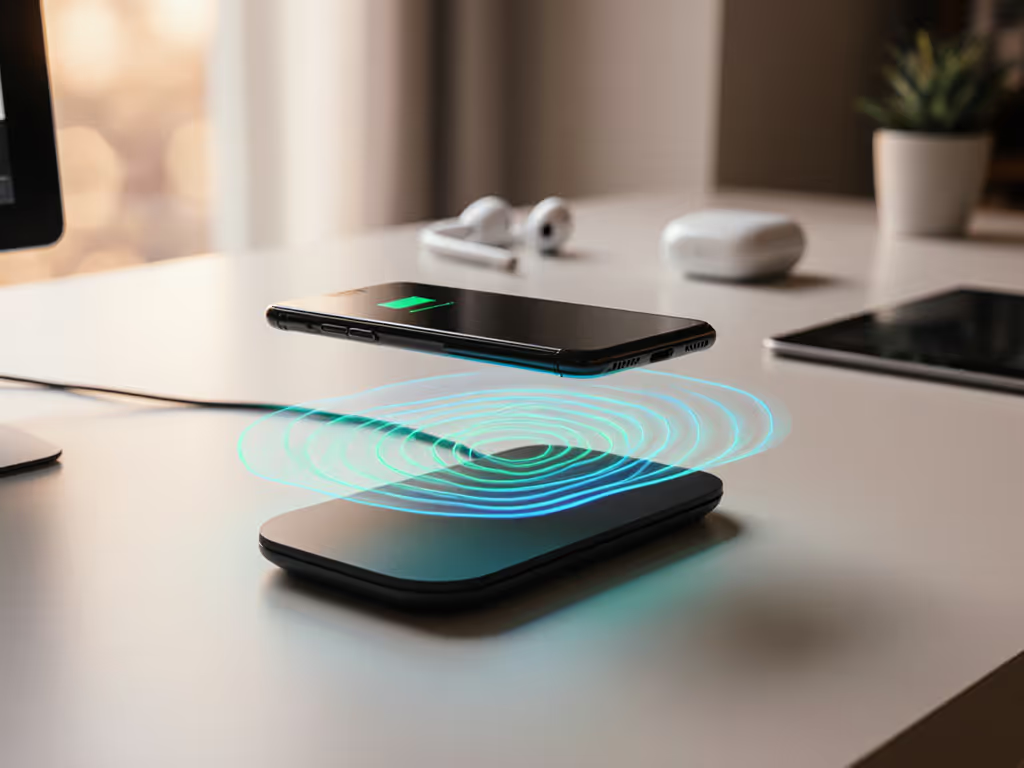
Qi2.2 (25W) closes that thermal gap. The refined MPP reduces wasted energy during power transfer, so less heat is generated in the first place. A Qi2.2 charger paired with a phone that supports 25W wireless (like the iPhone 17 and future flagships) can recharge a battery from 0 to roughly 50% in about 30 minutes, a speed that rivals a quick wired session, and without the fan noise or heat anxiety that plagued earlier attempts.
This matters for battery health. Lithium-ion cells degrade faster at elevated temperatures. A cooler charge path, whether via better thermal design or lower-heat-per-watt delivery, directly translates to longer battery lifespan. Protect the pack, and performance naturally lasts the distance.
Magnetic Alignment: Why Precision Beats Raw Power
It's tempting to assume that a faster standard simply cranks up the watts. But raw power without precision is waste and heat.
Qi2.2's improved magnetic alignment ensures your device snaps into the optimal charging position automatically, which means the charger can safely operate at higher power without misalignment interruptions. This is critical: a weak magnet or sloppy coil alignment at 25W would turn your phone into a hand warmer. Strong, precisely positioned magnets allow the charger to push 25W while keeping the coil-to-device coupling tight and efficient.
For multi-case households, or if you use both thin cases and rugged ones, this precision matters immensely. A well-certified Qi2.2 pad will charge reliably through a typical case, whereas older Qi chargers often lost alignment (and performance) with anything thicker than a thin TPU bumper.
Backward Compatibility: You Don't Have to Throw Everything Away
One of the biggest fears when a new standard launches is obsolescence. With Qi2.2, that fear is misplaced.
A phone or tablet that supports Qi2.2 will still work with older Qi and Qi2 chargers, you'll just be limited to their maximum speeds. If your older Qi2 pad maxes out at 15W, a Qi2.2-ready device will charge at 15W on that pad, not 25W. Conversely, an older device that only understands Qi or Qi2 (but not Qi2.2) can sit on a new Qi2.2 charger and charge at whatever speed it natively supports, no harm done.
This grace period is crucial for households with mixed devices, travel setups where you share chargers, or multi-user homes where guests plug in their phones. Health-first beats hype, and that means not forcing an immediate, expensive upgrade for everyone in your ecosystem.
Qi2.2 Charging Performance: Real-World Expectations
Advertised wattage is not the same as realized charge speed, and that gap is where real-world complexity lives.
For a Qi2.2 charger to deliver full 25W, several conditions must align:
- The device must support Qi2.2 or equivalent wireless charging at 25W. Older phones max out at lower speeds; even newer models may be limited by their own hardware. iPhone 17 supports up to 25W via Qi2.2, but not all Android flagships will.
- The power adapter feeding the charger must supply sufficient current. A weak USB-C brick or fraying cable will bottleneck the system, and the charger will negotiate a lower power level to avoid failure. You'll want a certified GaN (gallium nitride) power adapter, typically 30W or higher, to unlock 25W wireless charging reliably.
- Alignment, case thickness, and ambient temperature all play a role. A thick case, misalignment, or a phone that's already warm from navigation or video will cause the device to request less power to stay within thermal limits. This isn't a flaw, it's protection.
- Proper certification matters. A pad labeled "Qi2.2-compatible" isn't the same as "Qi2.2-certified." Certification involves rigorous testing of magnet strength, coil placement, thermal output, and foreign object detection (FOD) safety. Don't skip this step. Learn how to verify genuine Qi2 certification before you buy.
In a best-case scenario, cool room, thin case, modern phone, proper power brick, you'll feel the speed. In a cramped car mount or warm office, the system will throttle gracefully, keeping heat and battery stress in check. That's not a bug; it's the standard doing its job.
Why Qi2 Still Matters
Qi2.2 is the newer specification, and for new purchases, it's the obvious choice. But Qi2 (15W) isn't suddenly obsolete.
For overnight charging, desk work, and any scenario where speed isn't urgent, Qi2 delivers reliable performance with excellent thermal behavior. It's also more affordable than Qi2.2 pads, a meaningful factor for households outfitting multiple rooms or upgrading a multi-device setup.
Qi2 also has years of market maturity and ecosystem support. If you're buying a charger today and plan to keep it for 3-5 years, Qi2 pads are proven, widely available, and will continue to work reliably with future devices via backward compatibility.
The real question isn't whether Qi2 is good enough, it is. It's whether the faster charging time of Qi2.2 justifies the higher price for your specific use case. If you do frequent quick top-ups or own devices that support 25W wireless, Qi2.2 makes sense. If overnight charging works for your routine, Qi2 is still the smarter financial choice.
Building Your Ecosystem: A Practical Perspective
The rise of standardized wireless charging standards like Qi2 and Qi2.2 has dismantled one of the biggest pain points: proprietary lock-in. Unlike MagSafe (which remains Apple-exclusive for fastest speeds), both Qi2 and Qi2.2 are open standards developed by the Wireless Power Consortium, meaning they work across iPhones, Android phones, tablets, and future wearables from any manufacturer.
For renters, office managers, and multi-user households, this is transformative. A single Qi2.2 charger can serve an iPhone user, a Samsung Galaxy owner, and a visitor with a Pixel, all without friction.
If you're building a fresh setup, prioritize Qi2.2 for your main desk and bedroom spots, where a single charger might serve you for years. Reserve Qi2 pads for secondary locations, travel kits, or shared spaces where speed is less critical. Both standards will coexist peacefully, and devices will negotiate the fastest available speed automatically.
Heat, Battery Health, and the Bigger Picture
Throughout this comparison, temperature keeps surfacing, and for good reason. Wireless charging has historically fought a heat problem: pushing power across the air gap between coils generates thermal loss, and at 15W, that loss was manageable but noticeable. At 25W, without precision and efficiency improvements, heat would spiral.
Qi2.2's refined Magnetic Power Profile addresses this by tightening the coil-to-device coupling, reducing energy waste, and improving the charger's ability to throttle intelligently when thermal limits approach. Modern phones also monitor their own temperature and will request less power if they warm up, a safety mechanism that's invisible but essential.
For a device that will be used daily for 3-5 years, every degree matters. A consistently cool charging experience extends battery lifespan measurably. This is why Qi2.2 is not just faster, it's also safer for your device's long-term health.
Moving Forward
The evolution from Qi2 to Qi2.2 mirrors the broader maturation of wireless charging: from a convenience feature plagued by inconsistency to a genuinely practical alternative to wired charging. The 25W ceiling is impressive, but the real achievement is delivering that power safely, reliably, and with minimal thermal penalty.
As you evaluate chargers for your desk, car, nightstand, or travel bag, ask yourself: What's my real-world charging pattern? Am I chasing the fastest possible top-up, or is overnight charging fine? Do my devices support 25W, or will I max out at 15W anyway? And critically, do I have the right power brick and cable to unlock that speed without risk?
Those answers will clarify whether Qi2.2 is an upgrade for you or whether Qi2 remains the practical choice. Either way, you're no longer gambling on misalignment, proprietary lock-in, or heat spikes. The standard is finally doing what it promised: making wireless charging work the way you expect it to.
As you continue researching wireless charging solutions for your specific spaces, car mounts, office setups, guest rooms, or travel kits, look for real-world testing data, Wireless Power Consortium certification seals, and user feedback on thermal behavior under load. Lab-verified recommendations, not marketing noise, will steer you toward a setup that stays cool, charges reliably, and keeps your devices healthy for years to come. For measured results across brands, see our Qi2 25W thermal throttling tests.
Related Articles