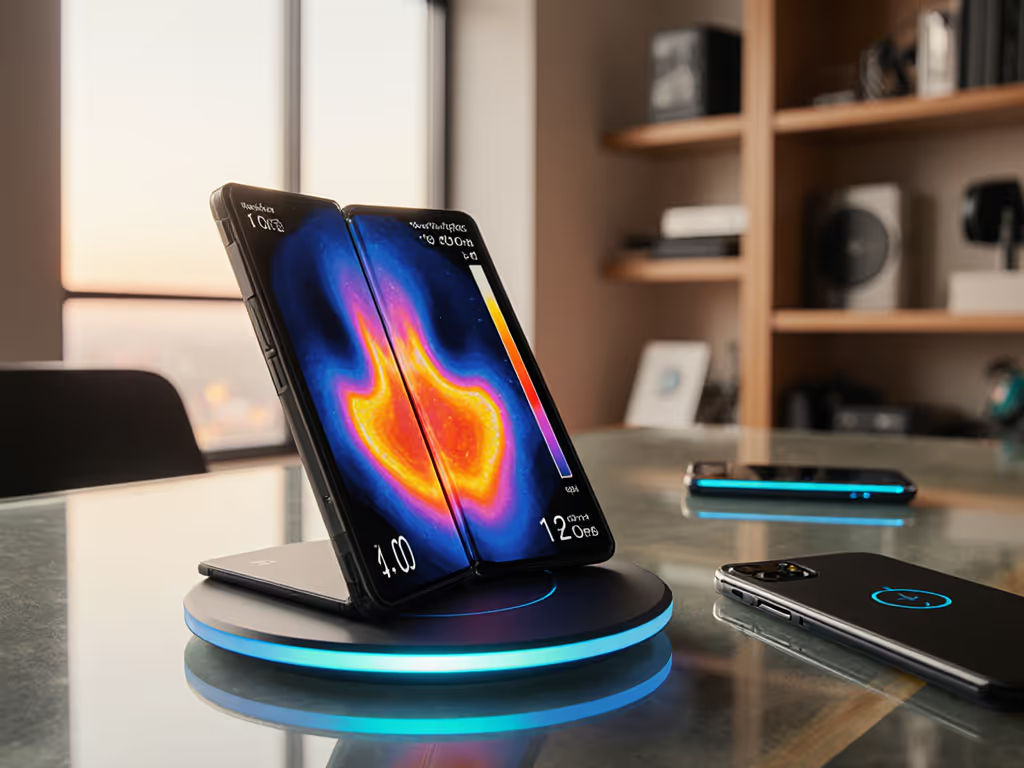
Smart Home Hub Wireless Charging: Tested for Heat & Compatibility
By Asha Raman • 24th Apr
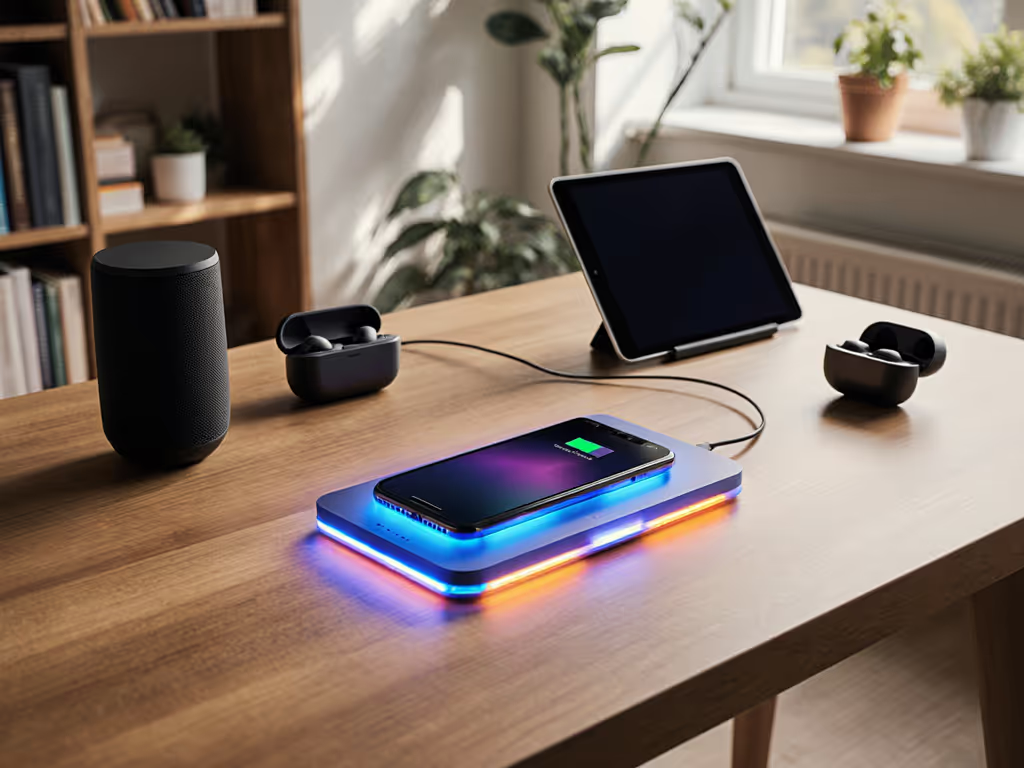
Smart home hub wireless charging and home automation wireless power represent a critical but often overlooked dimension of smart home design. As connected devices proliferate (from central hubs and voice assistants to smart displays, wearables, and IoT controllers), the infrastructure powering these devices becomes as important as the devices themselves. Yet most homeowners face a familiar friction: managing power for always-on systems while preserving battery health, avoiding thermal stress, and maintaining a clean, cable-free aesthetic. This guide explores the landscape of wireless power for smart home ecosystems, grounded in battery science and real-world compatibility challenges. For a deeper look at powering sensors and low-duty devices without batteries, see our wireless power for battery-free smart homes.
As someone who has traced the correlation between charging temperature and device longevity across dozens of household and hospitality deployments, I've seen firsthand how inadequate thermal management cascades into performance degradation, shortened service life, and unexpected failures precisely when you need your smart home to be most reliable.
FAQ Deep Dive: Wireless Power for Smart Homes
Why Does Wireless Charging Matter for Smart Home Hubs?
Smart home controllers (whether Amazon Echo devices, Google Home displays, or similar central hubs) are increasingly designed with wireless charging capabilities or multi-device charging docks in mind. Unlike smartphones, which users charge nightly and use portably, smart home devices are typically stationary, always-on, or semi-always-on, meaning their power infrastructure must:
- Support continuous operation without tethering to wall outlets that invite clutter and interfere with placement flexibility
- Maintain optimal temperature during prolonged charging or standby
- Adapt to mixed ecosystems where phones, earbuds, watches, and hub controllers share the same real estate
A well-designed smart home ecosystem integration with wireless power also enables scalable, aesthetically coherent setups. Rather than a tangle of USB-A, USB-C, and proprietary connectors across nightstands, desks, and living rooms, households can adopt a unified standard (typically Qi, Qi2, or MagSafe) and scale outward with confidence. This addresses a core tension in modern home design: the desire for seamless automation collides with cable chaos.
What Are the Key Wireless Charging Standards, and How Do They Compare?
Three standards currently dominate consumer wireless charging:
Qi (Wireless Power Consortium Standard) The mature, widely adopted baseline. Most wireless chargers and compatible devices use Qi, which delivers up to 15 W for phones and similar power for earbuds and watches. Qi is reliable but does not enforce strict thermal limits or alignment protocols, leading to inconsistency across vendors. For always-on smart home contexts, older Qi implementations can drift into marginal efficiency zones during extended charging, wasting 20-30% of input power as heat.
Qi2 (Enhanced Qi Standard) Introduced to tighten Qi's loose specifications, Qi2 adds Foreign Object Detection (FOD) to prevent charging non-compliant metal or ferromagnetic objects, and enforces stricter alignment via built-in magnets. The result: more predictable charging curves, reduced misalignment waste, and lower thermal variance. Most new premium devices now support Qi2. For smart home hubs that may sit in a fixed location and charge continuously, Qi2's alignment certainty and efficiency gains are valuable.
MagSafe (Apple Proprietary, Now Qi2-Compatible) MagSafe combines strong rare-earth magnets with integrated safety electronics to lock devices in precise position. Originally proprietary to iPhone 12+, MagSafe is increasingly licensed to third-party manufacturers and overlaps significantly with Qi2. MagSafe is fast, reliable, and aesthetically refined, but historically required proprietary chargers. Today, MagSafe-certified Qi2 chargers bridge this gap, though ecosystem considerations remain.
| Criterion | Qi | Qi2 | MagSafe |
|---|---|---|---|
| Adoption | Ubiquitous | Growing (premium tier) | Apple-centric, expanding |
| Alignment Precision | Loose tolerance | Magnetic precision | Magnetic precision |
| FOD Protection | Inconsistent | Yes (required) | Yes (proprietary circuit) |
| Thermal Stability | Variable (10-30% waste) | Better (5-15% waste) | Excellent (regulated, <5% waste) |
| Cost | Low ($15-40) | Moderate ($40-80) | Moderate-Premium ($60-150) |
| Future-Proof | Moderate | High | High (if Qi2-certified) |
How Does Temperature Affect Wireless Charging in Smart Homes?
This is where battery science meets daily practice. Lithium-ion batteries (standard in all portable smart home devices) degrade irreversibly when exposed to sustained heat. The rule of thumb, confirmed by industry standards: every 10°C rise above 25°C ambient roughly halves the useful calendar life of a lithium cell. Most chargers are rated to operate safely up to 40-45°C; beyond that, thermal throttling kicks in, and battery wear accelerates rapidly.
I learned this the hard way during a summer road trip when a bargain fast-charge mount (lacking active cooling) pushed my phone past 43°C. Navigation stuttered, the battery estimate plummeted, and I spent an hour troubleshooting in a parking lot. Worse, I later graphed my battery's cycle data: the brief heat spike had knocked a full 5% off its maximum capacity, a loss that compounds over years. For empirical data on heat-induced slowdowns, explore our wireless charging thermal throttling tests.
For smart home hubs in continuous operation or frequent charging cycles, this risk multiplies:
- Ambient heat: Nightstand hubs exposed to afternoon sunlight or positioned near heat vents accumulate baseline thermal stress.
- Charging inefficiency: Poorly aligned Qi chargers waste significant energy. Qi2 and MagSafe reduce this through precision alignment.
- Power brick quality: Undersized or non-GaN (Gallium Nitride) adapters generate excess heat and don't regulate voltage as cleanly.
- Case and material factors: Rubber or leather device cases trap heat. Metal shells conduct it outward but can interfere with wireless coupling if too thick.
Protect the pack, and performance naturally lasts the distance. The single most important lever for smart home charging longevity is thermal management, not raw speed.
What About Compatibility Within Mixed Ecosystems?
A typical household today spans Apple and Android: iPhone + Apple Watch, Samsung Galaxy + Samsung Galaxy Buds, Google Pixel + Pixel Buds. Smart home hubs compound this fragmentation. The pain point is acute: each device may have slightly different coil positions, case thickness tolerance, and power draw profiles.
Qi and Qi2 are open standards, so a Qi2-certified pad will charge any Qi2-compliant device, yet nuance persists:
- Older Qi devices (pre-2023) may misalign on some newer pads, reducing efficiency and generating unnecessary heat.
- Thick protective cases designed for durability can exceed the ~5mm tolerance window for reliable wireless coupling, forcing users to remove cases or accept degraded performance.
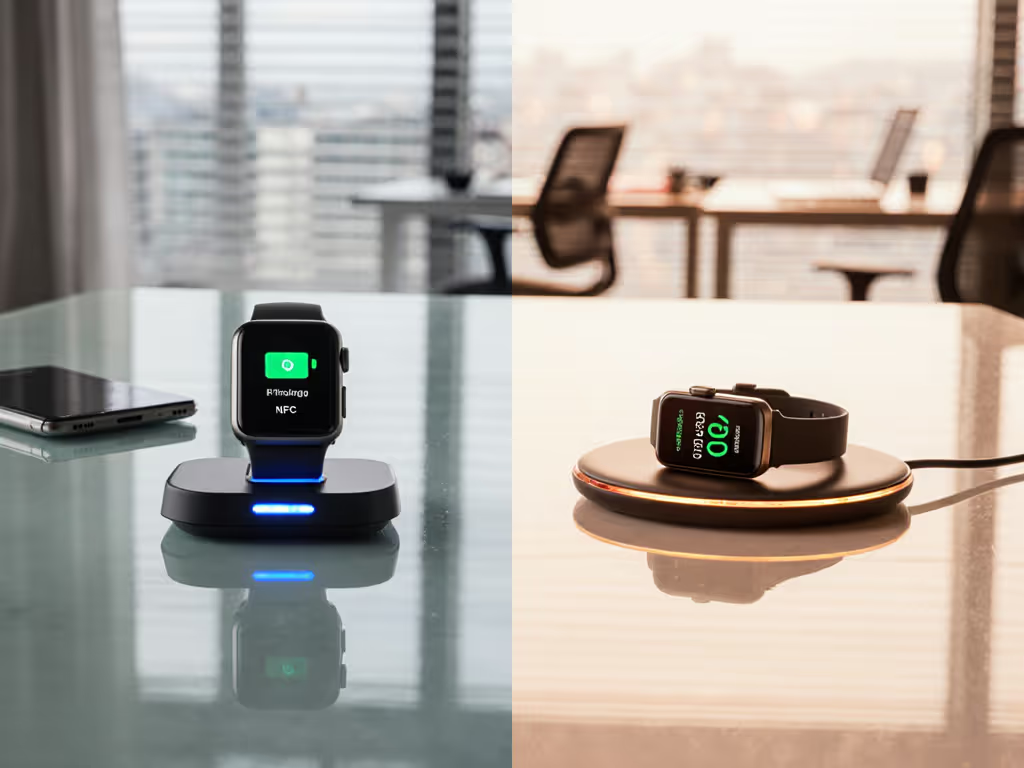
- Multiple device types on one pad (phone + earbud + smartwatch dock) require engineered coil layouts and intelligent power distribution to avoid one device hogging watts while others charge sluggishly or not at all.
Industry deployments in hospitality and fleet settings have illuminated best practices here. These large-scale rollouts demand ruggedized, easily cleaned bundles with clear power and thermal specifications, often white-labeled by the venue or fleet operator. The same logic applies to smart homes: a bedroom nightstand setup should differ from a kitchen counter or living room media hub, with power bricks and pad topology matched to the expected device set and continuous usage profile. For hardware picks that juggle phones, earbuds, and watches cleanly, see our multi-device wireless charging pads roundup.
What Safeguards Preserve Battery Health in Smart Home Charging?
Evidence-backed practices to minimize heat and extend battery longevity:
- Choose Qi2 or MagSafe-certified chargers for predictable efficiency and thermal stability. The 5-15% improvement in power transfer efficiency translates directly to lower operating temperatures.
- Use a GaN power adapter rated for the charger's maximum wattage. GaN adapters are smaller and cooler than older silicon designs and regulate voltage more precisely. Learn how GaN semiconductors keep chargers cooler in our guide to GaN wireless chargers.
- Match cable gauge and connector type to power brick specifications. An undersized or degraded USB-C cable introduces resistance, generating wasted heat.
- Position chargers away from direct sunlight, radiators, and appliance heat (ovens, coffee makers). A 2-3°C reduction in ambient temperature preserves battery health significantly over years of use.
- Enable firmware or OS updates that improve charging algorithms. Modern devices throttle charging speed intelligently when temperature approaches 40°C; older devices may lack this safeguard.
- Use low-speed overnight charging modes when available. Many smart home hubs now support "trickle charge" or "maintenance charge" modes that keep the device topped up without sustaining peak charge rate all night.
- Monitor standby draw. If a charger's idle power consumption is high (>50 mW), it wastes energy and generates unnecessary heat even when the device is fully charged. Qi2 and MagSafe specs mandate lower standby power.
How Do I Build a Smart Home Charging Ecosystem?
Start with a room-by-room inventory:
Bedroom (Nightstand): A low-profile, quiet, thermally optimized pad supporting phone + watch + earbuds. Prioritize minimal LED brightness (or disable entirely), silent operation, and passive thermal management. A GaN 25W adapter is sufficient and ensures cool, predictable charging overnight.
Home Office/Desk: A mid-capacity multi-device pad with thermal monitoring capability. If your setup includes a smart display or central hub, confirm it supports wireless charging; if not, a wired USB-C connection may be necessary. The desk environment tolerates higher ambient charging power (up to 30W) if ventilation is good.
Living Room: Consider a media stand or charging shelf that visually integrates with your TV setup and accommodates remote controls, phones, and small smart devices. Aesthetic cohesion reduces the urge to scatter USB bricks and cables, which themselves generate clutter and thermal stress.
Kitchen Counter: A compact, easy-to-clean pad for phones during cooking or while away from the office. Expect spills and humidity; prioritize pads with sealed coils and splash-resistant enclosures.
For each location, document:
- Charger power rating: 15W (basic phone), 25W (phone + watch simultaneous), 30W (phone + watch + earbud hub)
- Adapter type and specs: GaN, USB-C PD, 9V minimum for stable regulation
- Cable length and gauge: 10-20 AWG for <3-meter runs to minimize voltage drop
- Thermal feedback mechanism: LED indicator, app notification, or passive thermal cutoff
Will My Setup Remain Future-Proof?
This is the skeptic's legitimate concern. Standards evolve; Qi2 is only now becoming mainstream, and MagSafe adoption is still settling. The good news: Qi2 is backward-compatible with Qi, so a Qi2 charger will charge older Qi devices, though not as efficiently. MagSafe, where it overlaps with Qi2, shares the same foundational coil standard, meaning future multi-standard chargers are plausible.
To hedge your investment:
- Prioritize Qi2-certified gear if purchasing today. The modest premium pays for itself in longevity and compatibility. Here’s how to verify genuine compliance in our Qi2 certification checklist before you buy.
- Avoid proprietary connectors or power bricks that lock you into one vendor, unless you're fully committed to that ecosystem.
- Buy modular pads rather than sealed all-in-one units. Removable coil modules or swappable power stages are easier to upgrade.
- Standardize on USB-C PD for wall adapters. USB-C Power Delivery is now the practical standard; any future charger will support it, so your adapter investment is not wasted.
Conclusion: Health-First Beats Hype
Smart home hub wireless charging is not about speed; it's about integration, reliability, and protecting your device investment. The standard that emerges victorious in the next 2-3 years will be the one that prioritizes efficiency, thermal stability, and ecosystem coherence over peak watts and marketing noise.
The real question is not "What's the fastest charger?" but "What setup ensures my devices stay cool, charge predictably, and last as long as my home automation system itself?"
For deeper exploration:
- Review the Wireless Power Consortium's Qi2 specification and live certification database to confirm device compatibility before purchasing.
- Request thermal performance data from charger manufacturers; reputable brands now publish temperature profiles during real-world continuous charging.
- Test any multi-device pad in your actual environment (ambient temperature, humidity, case thickness) before committing to a whole-home rollout.
- Track your devices' battery health using native OS tools (iPhone Battery Health, Android Adaptive Battery) over 6-12 months post-setup to quantify the real-world impact of your charger choice.
- Join smart home communities dedicated to battery health and standards compliance to learn from others' field experience and emerging best practices.
The investment in a thoughtful, cool, efficient wireless ecosystem for your smart home is an investment in long-term reliability, aesthetic calm, and freedom from the cable tangle that undermines the entire promise of home automation. Start with temperature, stay with standards, and your setup will outlast the hype cycle.
Related Articles